


Sweaty palms don’t limit climbing progress—poor chalk management does. Most slick-handed climbers pursue two ineffective paths: compulsive rechalking until holds turn white while friction remains inadequate, or purchasing premium products without behavioral modification. Neither addresses the underlying issue.
The High-Probability Setup
For significant perspiration, prioritize: liquid chalk base layer at session initiation, minimal loose chalk supplementation only when friction noticeably declines, and systematic hold brushing before limit attempts. The objective isn’t perpetually white hands—it’s maintaining stable, predictable friction throughout the session.
Product recommendation for immediate implementation: Friction Labs Secret Stuff Liquid Chalk delivers the most significant consistency improvement for sweaty hands in typical indoor environments.
Dispelling the Central Myth
“More chalk equals more grip”—repeated constantly, supported rarely. A 2001 Journal of Sports Sciences friction study (Li et al., PMID 11411778) demonstrated that under controlled conditions, chalk actually reduced measured friction coefficient compared to bare skin. This doesn’t invalidate chalk’s utility in modern climbing contexts; it reveals that excessive application undermines performance, and friction optimization requires nuance beyond endless powder accumulation.
Elite climbers typically succeed through superior application discipline: reduced volume, strategic timing, and thorough hold preparation.
The Four Variables That Determine Performance
Indoor friction for sweaty hands depends on: skin moisture level, chalk format selection, atmospheric and hold surface conditions, and application behavior. Product choice cannot compensate for poor technique.
Kevin Brown of FrictionLabs, quoted in Climbing Wall Association guidance, notes that excessive chalk functions as “dry lubricant,” degrading rather than enhancing grip. The critical shift: optimize dosage and timing, not merely brand selection.
Normalizing the Condition
Hyperhidrosis exceeds climbing-specific concern. U.S. prevalence research (Archives of Dermatological Research) estimates 4.8% population incidence—approximately 15.3 million individuals—with 70% of affected respondents reporting severe sweating in at least one body region, yet only 51% having discussed symptoms with healthcare providers. Persistent hand perspiration through climbing attempts indicates common physiological variation, not personal deficiency. What matters is developing reliable management systems.
Format Selection and Strategic Application
Liquid Chalk—optimal base layer. Rapid drying, uniform initial coating, generally reduced dust generation compared to loose-only approaches. A 2021 mSphere study (McAuley et al., PMID 34133201) identified significant liquid chalk efficacy against SARS-CoV-2 and influenza A recovery in controlled conditions. For climbing performance, the practical advantage is consistency: thin foundation layers enable more predictable supplementation throughout sessions. Limitations include potential irritation of damaged skin, excessive drying with overuse, and occasional slickness when over-applied. Deploy at session start, before limit attempts, and preceding high-humidity climbing blocks.
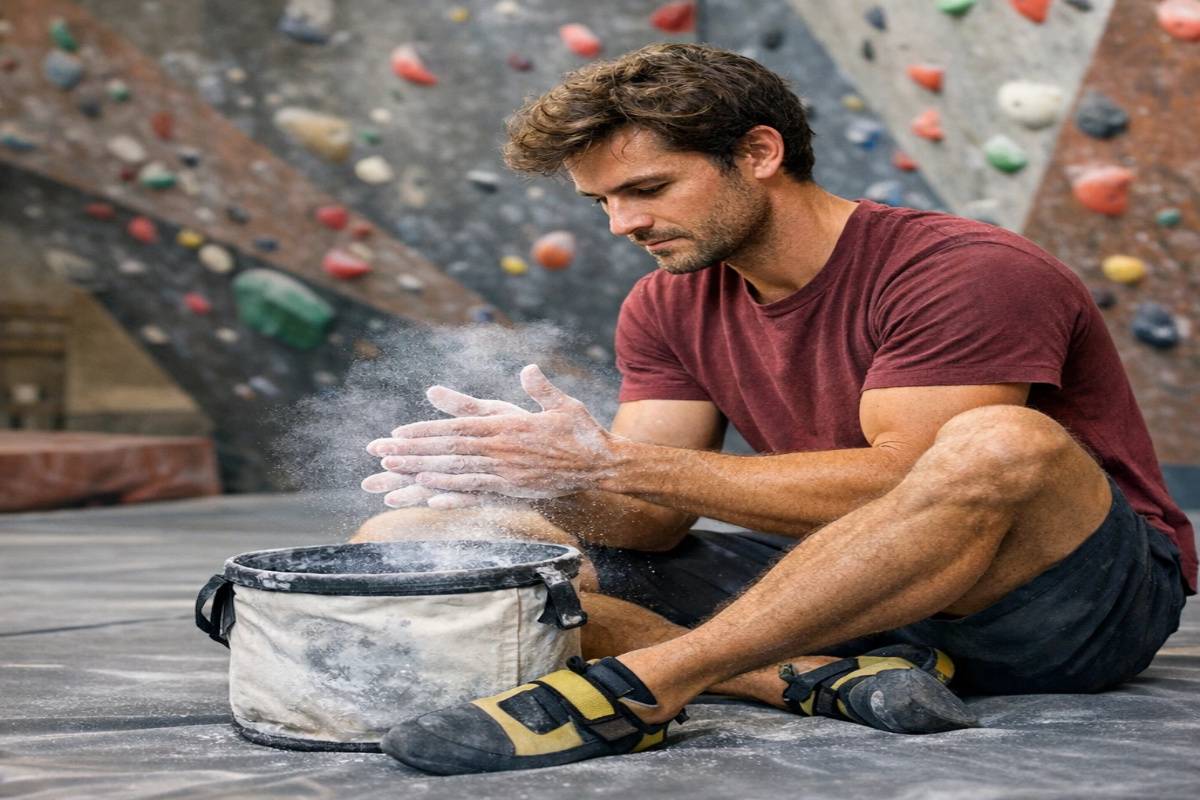
Loose Chalk—controlled top-ups. Rapid reapplication, familiar tactile feedback, micro-dosing capability once restraint develops. Risks include overuse tendency, environmental and hold contamination, and performance degradation from excessive coating. Deploy sparingly post-brushing, never as constant reimmersion. Friction Labs Premium Loose Chalk serves effectively once liquid foundation establishes.
Chalk Ball/Sock—gym compliance necessity. Cleaner handling, spill reduction, frequently mandatory. No automatic friction superiority; potential inconsistency if densely packed. CWA dust guidance indicates spill prevention benefits without major airborne particle reduction compared to loose alternatives—ethanol-based liquid chalk demonstrated substantially superior dust suppression in referenced comparisons.
Policy-Driven Reality
Gym regulations increasingly restrict format options. The Cove Bouldering’s January 2024 policy exemplifies this trend: loose chalk prohibition, chalk ball and liquid chalk permitted. Optimal purchasing decisions therefore require facility-specific verification rather than theoretical performance optimization. When selecting primary climbing venues, incorporate local chalk policies into evaluation criteria alongside other amenities.
The right chalk isn’t the premium option—it’s the appropriately applied, gym-compliant option that maintains friction through intelligent management.